Posted by Rebekah Lowe / Thursday, December 1st, 2011
Dec. 1, 1878: The first telephone in the White House was installed.
Dec. 2, 1859: John Brown is hanged for his role in Harper’s Ferry raid.
Dec. 4, 1992: Bush orders troops to Somalia.
Dec. 6, 1884: The Washington Monument was completed.
Dec. 9, 2009: AOL declares an IPO the same day it ceases Time Warner partnership.
Dec. 14, 1799: George Washington died.
Dec. 16, 1960: Two airplanes collide, mid-air, over NYC.
Dec. 18, 1865: Slavery is abolished in the U.S.
Dec. 20, 1783: Virginia cedes western land to the government.
Dec. 23, 1888: Van Gogh chops off his ear.
Dec. 25, 1776: George Washington crosses the Delaware.
Dec. 28, 1981: Elizabeth Jordan Carr born in Norfolk, 1st American test tube baby.
Dec. 30, 1922: The U.S.S.R. is established.
Dec. 31, 1978: U.S. ends relations with Nationalist China.
-Lynn Norusis
Sources: Encyclopedia Virginia, HisDates.com, History Channel
(December 2011)
Alexandria Marina Ships In History and Fun
Posted by Lorin Drinkard / Tuesday, September 20th, 2011
Tuesday, September 20, 2011
For the waterfront in Alexandria, it’s about time for a lesson. A history lesson, that is. Starting October 4th, a new vessel will be coming to town and bringing its educational implications with it.
The Godspeed, a life-size replica of one of the 17th century ships that first brought English colonists to Virginia, is departing its port at Jamestown Settlement with its sails set toward Northern Virginia. From October 4th to 9th, the Godspeed will be docked at the north end of the Alexandria Marina and open for public tours.
Ever wanted to learn more about that historical journey in 1607 and life on the open seas? Knowledgeable guides will be on deck to share interesting tidbits about everything from navigation to sailing techniques in the 17th century.
Fun fact about the Godspeed: Mr. Bartholomew Gosnold was the fearless captain that led the original journey across the sea, as well as a key player in organizing backing for the Jamestown colony.
Even our fourth grade students in Alexandria Public Schools will be partaking in this hands-on learning experience by taking visits to the ship throughout the school week.
Along with the Susan Constant and the Discovery, the Godspeed is one of the ships dubbed “the official fleet of the Commonwealth,” according to the Virginia General Assembly. Kind of like the Air Force One of the sea.
Below are the times the ship is open for exploring:
October 4-7: 3 to 6 p.m.
October 8: 10 a.m. to 1 p.m.
October 9: 10 a.m. to 6 p.m.
Kudos to the Jamestown Settlement, a state-operated museum that’s helping to keep Virginia’s past alive and well, and to the staff and volunteers at the Jamestown-Yorktown Foundation for manning the ship. Tours are free and the Godspeed will be only be gracing us with its presence briefly so visit while you can.
Dates: October 4-9, 2011
Location: Alexandria Waterfront, by Founders Park (near North Union & Queen St.)
Cost: free
Contact info:
Jamestown Settlement
(888) 593-4682 or (757) 253-4838
www.historyisfun.org
Posted by The Editorial Desk / Wednesday, December 29th, 2010
NoVA boasts highest home vacancy rate in region
Sterling bank robbed by Hillary Clinton look-a-like
Are VA students learning the right history? Answer, No.
Toll Road prices go up to $1.25 for cars
Posted by The Editorial Desk / Wednesday, September 16th, 2009
The Reston Museum reopens its doors this week after spending eight months revitalizing the space where the town’s history is told
By Chase Johnson
September 16, 2009

Photography by Chase Johnson
The Reston Museum and Shop will reopen its doors this week after closing in January to undergo a much-needed and long-awaited overhaul. The celebration will begin with an invitation-only ribbon cutting event Thursday night before opening to the public Friday.
Eight months ago, the museum was a meager but well-intentioned hole in the wall pocketed in Lake Anne Center. It housed a hodgepodge of historical Reston miscellanea, comprised mainly of attic treasures, photographs and historical documents. Members of the Reston Historical Trust, which operates the museum, presented the story of Reston the New Town as best as they could, but it lacked the cohesion and professional look of a proper museum.
“It was just run on a shoestring,” Lynn Lilienthal, chair of the Reston Historical Trust Board of Trustees, recalls.
For four years, the museum had been cutting through miles of red tape seeking money to pay for a renovation. “The whole space hadn’t been renovated in 45 years,” Lilienthal says. “The air conditioning and the heating, everything needed to be upgraded.”
Finally, with the help of Hunter Mills Representative to the Fairfax County Board of Supervisors Cathy Hudgins, the museum received two grants totaling nearly $250,000—the first from Fairfax County Housing and Community Development Committee and the other from the Fairfax County Office of Community Revitalization and Reinvestment.
The space was gutted and completely redecorated. The room itself is a muted charcoal gray from floor to ceiling, which was done in order to make the colors of the exhibits pop. The museum features 12 exhibition panels that jut out from the walls diagonally. These panels tell the history of the town, and feature photos and artifacts that illustrate the story.
The museum brought back the topographical map of Reston that was donated to the museum when it first opened. “That was always our best thing because people love to look at it and say, ‘There’s my house!’” Lilienthal says. “We’ve upgraded that, and provided two photographs of the Town Center, which wasn’t even on that map because the map stopped [being updated] in 1984.”
Other details dot the walls, including photographs of the town, various proclamations and a golden sledgehammer used to drive in the final spike at the Wiehle Avenue Bridge. Even the bathroom is an exhibit, as the room is filled with signs and posters from Reston events past.
Lilienthal is looking forward to seeing the public’s reaction.
“It’s really the first time that the community is invited in to see it, and we hope that lots of people will come in over the weekend and the following weekends,” Lilienthal says. “Before, we did what we could with very little resources. This tells the story in a very professional way.”
For more information, visit RestonMuseum.org or call 703-709-7700. The museum is located at 1639 Washington Plaza in Reston, and is open from noon to 5 p.m. Tuesday through Friday and Sunday, and 10 a.m. to 5 p.m. on Saturday.
Posted by The Editorial Desk / Wednesday, November 1st, 2006
How History Lives in Virginia
By Samantha Cleaver
As December concludes the Year of the Museum, we celebrate the so-called “living” museums within easy driving distance of Northern Virginia.

19th century spinning at Explore Park in Roanoke. Courtesy of Explore Park
Martha Washington sits on a bench outside her house in Mount Vernon. Her white skirts fall neatly to the ground; a pair of sewing scissors hangs from her waist. Her sheer shawl is tucked into a clasp of flowers, and her white hair is pulled back under a mop hat. Martha’s hands are busy, pulling white yarn back and forth, over and under, a flower needlepoint. As she works, a group of families dressed in shorts and t-shirts, cameras hanging from their necks, approaches. Two boys lick orange lollipops decorated with Washington’s profile.
“Well hello!” Martha says, in a high sing-song voice.
“Hello,” they reply. The adults are delighted, the children amused.
“Now,” Martha says, looking at the boys. “When you approach a lady, especially an old one, you must bow. You put your best foot forward. So, whichever one is your best, put that one forward. Everyone do that now.” The boys put one foot forward. “Then, you put the other foot back. Take your cap in your hand. If you don’t have a cap, pretend you do. Good! Now, lean forward with a sweeping gesture.” The boys lean forward in unsteady bows. Behind them, their parents watch, grinning. “Wonderful! Most excellent! And, when you greet someone, the proper salutation is ‘Good day to you.’”
“Good day to you,” they repeat.
“Where is George?” A woman asks.
“Well,” Martha says, thinking, “he is riding his horse across the farm. I saw him ride towards the mill earlier. Perhaps he will be back later.”
With a final wave, the group leaves, the sound of their flip-flops resonates as they walk to the mansion. “Let’s take a rest inside, shall we?” Martha suggests. We walk down a path and through a gate, into a red-brick administrative building that blends into the background. As we cross through the gate, Martha’s voice changes; it becomes flat, modern. Her face relaxes. She becomes Mary Wiseman once again.

Henricus Historical Park / Courtesy of County of Henrico Division of Recreation & Parks
The Other 98 Percent
On the other side of Northern Virginia, a sign at Claude Moore Colonial Farm in McLean reads: After you visit Mount Vernon, see how the other half lived. “It’s more like the other 98 percent,” says Managing Director of the Farm, Anna Eberly.
At Claude Moore, it is 1771 and John Harbin and his family grow and harvest tobacco and wheat. The women cook meals over an open fire and tend to the children. Occasionally, they have a wedding or a market to attend. They are tenant farmers, eager to own land and move up in the world. The characters are fictional, but the research and presentation are authentic.
Improvising History: First-Person Interpreters
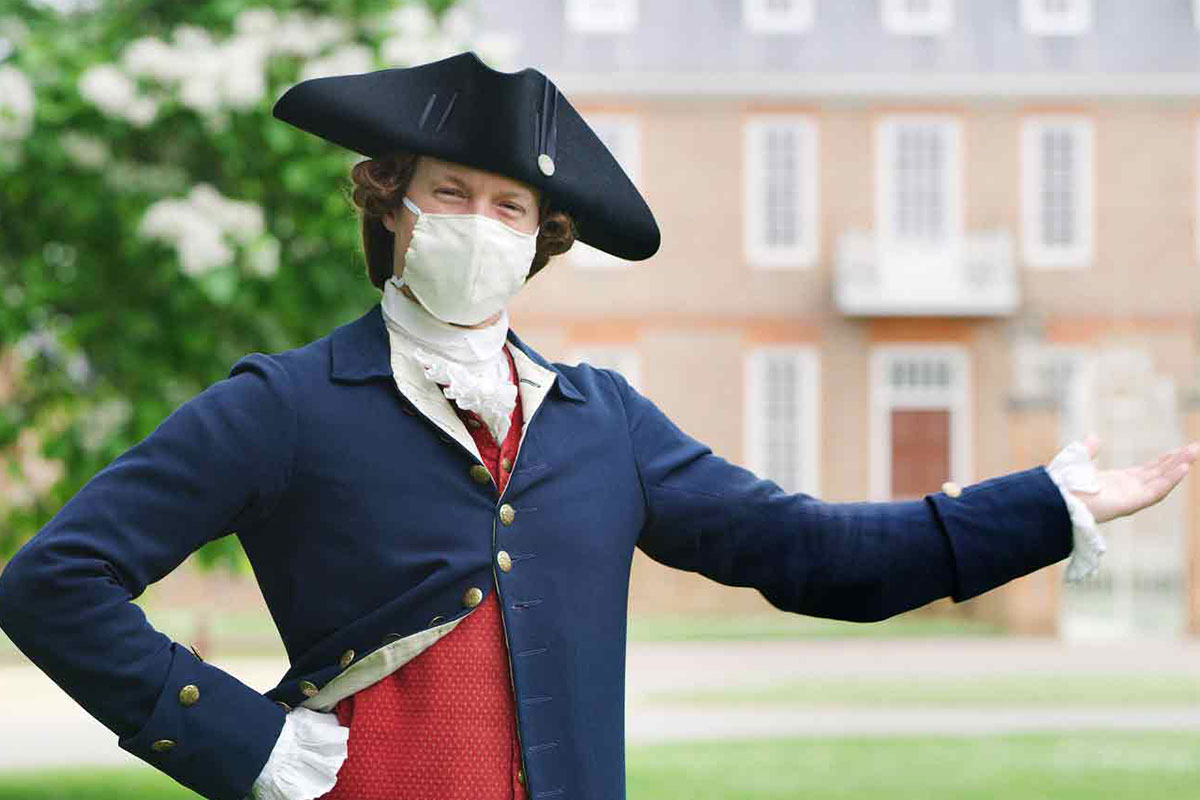
First-person interpreters become a character; third-person interpreters provide information while dressed in period clothing. When Martha Washington (Wiseman) chats with Mount Vernon visitors her goals are “to give a sense of [George] Washington as a father, husband, leader, military figure. I want visitors to understand how much he did. He really is a father figure for the country.” Wiseman is also working to accurately portray Martha Washington, a woman whose stiff, formal portraits don’t do her justice. “Martha was warm, friendly, and welcoming,” she says. “I’m putting the smile on her face.”
It’s the combination of acting and history that make first-person interpreters unique. Stacey Groves, Supervisor of the Mount Vernon Character Interpretation Program, tells first-person interpreters to answer three questions before they walk onto Mount Vernon’s grounds: “Who am I? Where am I? What am I doing? Once you have those questions answered—’I’m Mrs. Fairfax. I’m at the mansion. I’m here to see the General,’ you’re ready to go.” After that, it’s all improv.
Improvisation, says Jim Bradley, Public Affairs Manager at Colonial Williamsburg, requires more effort than acting out a scene, because “the person who does the portrayal must know that person, historically, backwards and forwards.” That’s what Ron Carnegie, a Williamsburg acting interpreter, likes about the job. When he answers visitors’ questions, he has to “consider the answer. How would my character answer it? How much does he know? And translate it into 18th century language and mindset, [and] determine whether or not it will still be understandable and not insulting to the modern guest.” All while talking.
Why Historical Interpreters Choose to Live in the Past
Like many interpreters, Wiseman portrays Martha Washington out of pure love. At times, she seems to find it difficult to separate from her character counterpart. “I’m only portraying her,” she says, as if reminding herself. “It’s a form of theatre, but it’s always about teaching. It’s not for myself. I’m not a re-enactor.” But even at home, Mary slips into Martha. “My kids say, ‘My mom is in the colonial zone,’” she says, grinning. “Every conversation I have can be tied to Martha Washington.”
Other interpreters fall in love with the interactions. Donald Kraft, who plays Mount Vernon’s overseer, Mr. Pierce, says he’s a natural ham and just likes it, including taking “the hundreds of photos a day.” At Claude Moore, Elizabeth Orlando, who plays the farmer’s sister, likes hearing visitors’ stories. “People want to find parallels [between their lives and history],” she says, “which is what we want them to do.”
Of course, first-person interpreters love the history. Jan Tilley, who plays John Harbin, the farmer at Claude Moore, likes his character, a pre-Revolutionary War tenant farmer. “It gives me a better understanding of the roots of the country,” he says. And, when asked of his impression of George Washington, John Harbin is frank. He doesn’t like him.
First-person interpreters provide visitors with unforgettable experiences, but there are downsides. Their scope is limited. They can’t put history into context for today’s visitors because, by virtue of their roles, they don’t live in the present. And, interpreters must resist the urge to connect the dots left by history. The history comes first; acting only fills in the gaps. “If the research isn’t there,” says Groves, “and not accurate, then it’s wrong.”
In Context: Northern Virginia’s Living History Museums
First-person interpreters are a familiar sight at area museums, but the living history genre is in jeopardy. Overall attendance is down, says John Caramia, Vice President of Education at Old Salem and former president of the Association of Living History, Farm and Agricultural Museums. Living history museums are competing with myriad other attractions for American’s precious leisure time. Gas prices are affecting group tour visits and may affect family travel. Tourists expect more technology than living history museums are used to providing. And, as with other outdoor venues, weather is always a factor.
Attendance at Northern Virginia museums, however, remains strong. On a good day, Mount Vernon has as many as 10,000 visitors. The Claude Moore Colonial Farm hasn’t seen a significant change in attendance. Part of the reason is the area; people visit Northern Virginia expecting to see the country’s beginnings. “This area is steeped in history,” says Anna Eberly. “There will always be an interest.”
Move Over Mickey: The Fun Side of Living History
With today’s pressures comes the threat of Disney-fying living history. The challenge, as Caramia sees it, is to keep programs within the mission of a museum. “We’re not a history amusement park,” he says.

Courtesy of Ash Lawn-Highland
To keep history fun and relevant, museums are focusing on their strengths: real, live history. At Ash Lawn-Highland they’re focusing on action in the form of large events. “People love living history,” says K. K. Pearson, Director of Education. “Attendance jumps for big events.” Jim Bradley agrees. “People are really engaged,” he says of Williamsburg’s “The Revolutionary City” street performance. “They get excited when Benedict Arnold comes in and tells them they’re under martial law. The people in 21st century clothing are yelling ‘traitor!’ at the top of their lungs, not the actors.” During Claude Moore’s annual Wassail, a traditional December ceremony that ensures a good spring crop, Anna Eberly watches party-goers pick up a pie pan and start beating trees. “We’ve always focused on participation,” says Eberly. “That’s where other museums are going.”
Some museums are expanding their first-person interpreter programs. Mount Vernon is working to double its first-person interpreter workforce by adding characters that knew Washington as a war leader. “The whole idea,” says Ann Bay, Associate Director of Education, “is to provide a richer experience and give multiple perspectives on Washington through people who knew him well.”
The debate in the living history community is one of survival. Does it have a future? John Caramia thinks it does, but museums “need to look past baby boomers to Generations X and Y.” He advises museums to evolve and change programs to meet visitors’ expectations. In Northern Virginia, living history definitely has a future. Anna Eberly sees a “very narrow but permanent niche for living history, as long as it’s done well.” And at Mount Vernon, Stacey Groves is confident. “People will always want to learn history,” she says, “but we need to keep living history really living.”

Buildings and historical interpreters inside re-created James Fort at Jamestown Settlement / Courtesy of Jamestown
Virginia’s Living History Museums
The Jamestown Settlement, in Williamsburg, provides visitors with a look at Virginia when it was first colonized in the early 1600s. Costumed interpreters that represent the English, Native American, and African cultures are ready to help visitors understand trade, ship building, economics, and other aspects of the new world.
At Henricus Historical Park in Chesterfield, an Indian Village, the second settled city in Virginia, the Citie of Henricus, a tobacco farm, and Mount Malady, a 1612 hospital, are available to show visitors Virginia’s origins.
At Virginia’s Explore Park in Roanoke interpreters at the 17th century Totoro Indian site make canoes and tell traditional stories. At the 18th century frontier fort, interpreters work on tanning projects and perform military drills. And, at the 19th century Valley Community, interpreters work on the farm and visit the one-room schoolhouse.
The Frontier Culture Museum in Staunton has four farms that show life in Germany, Northern Ireland, America, and England in the 17th and 18th centuries. Their living history interpreters are in costume during the spring, summer, and fall, when the farms are most active.
The Monacan Indian Village in Natural Bridge presents the history of the Monacan Indians as they lived in the mid-18th century, with an emphasis on how they used the area’s natural resources.
You can help with 18th century chores at the Claude Moore Colonial Farm, in McLean. Or come for a special event and spend time in period dress or participate in an 18th century wedding or a Wassail.

Courtesy of Yorktown Victory Center
The Yorktown Victory Center in Williamsburg shows what life was like for Virginians during the Revolutionary War through a re-creation of a continental army encampment.
This year Colonial Williamsburg debuted a two-hour street presentation, “The Revolutionary City,” that portrays life in Williamsburg before, during, and after the Revolutionary War.
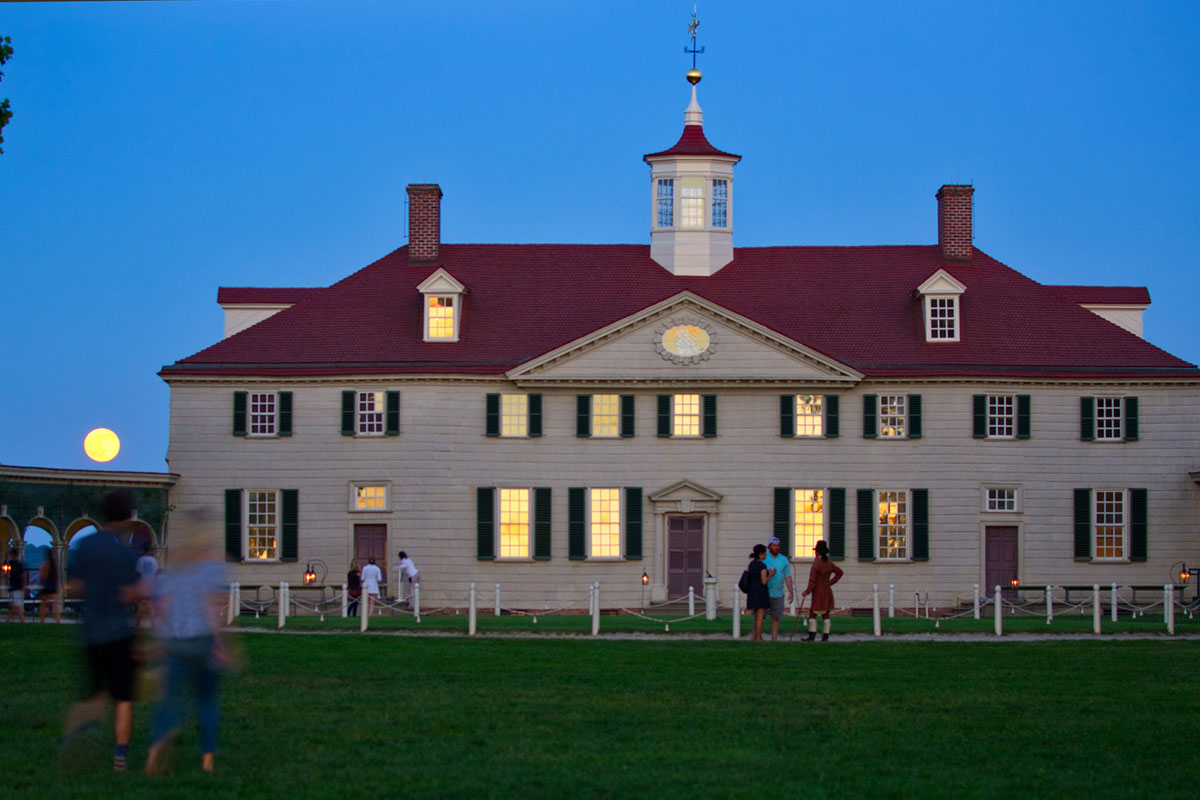
George Washington’s Mount Vernon in Alexandria shows the house in the years before Washington died (1787-1799). The best time to visit is fall and winter when lines are short and they have guided tours.
The birthplace of James Monroe, Ash Lawn-Highland, in Charlottesville employs a James Monroe who talks with visitors. They also have interpreters who lead visitors through military drills, and do spinning and weaving.
The Meadows Farm Museum in Richmond provides visitors with living history demonstrations that highlight agriculture and trades, including gardening, blacksmithing, and wood working from the mid-1800s. For a calendar of living history events, call 804.501.5520.

Robert E. Lee’s Stratford Hall / Courtesy of Stratford Hall
At Robert E. Lee’s home, Stratford Hall in Stratford, third-person interpreters lead you through the house. Come for a special event, like Lee’s birthday celebration on January 19th to meet the general himself.
Matthews Living History Farm in Galax presents living history exhibits from egg hunts to sheep shearing to harvesting during their monthly Heritage Days, between April and November.
At Old City Cemetery living history interpreters tell the story of Lynchburg. In the cemetery, a Victorian lady, dressed in black, explains Victorian era mourning rituals. At an old train station, a 19th century station agent greets visitors, and a World War I Red Cross volunteer explains Lynchburg’s role as a canteen stop. And, finally, at The Pest(ulence) House, a Civil War hospital, a Catholic nun talks about Civil War medicine. Schedule a guided tour before visiting.
(December 2006)